Why Property Prices in Dubai Are Going Up. Construction Costs, Materials and the Opening of the Strait of Hormuz.
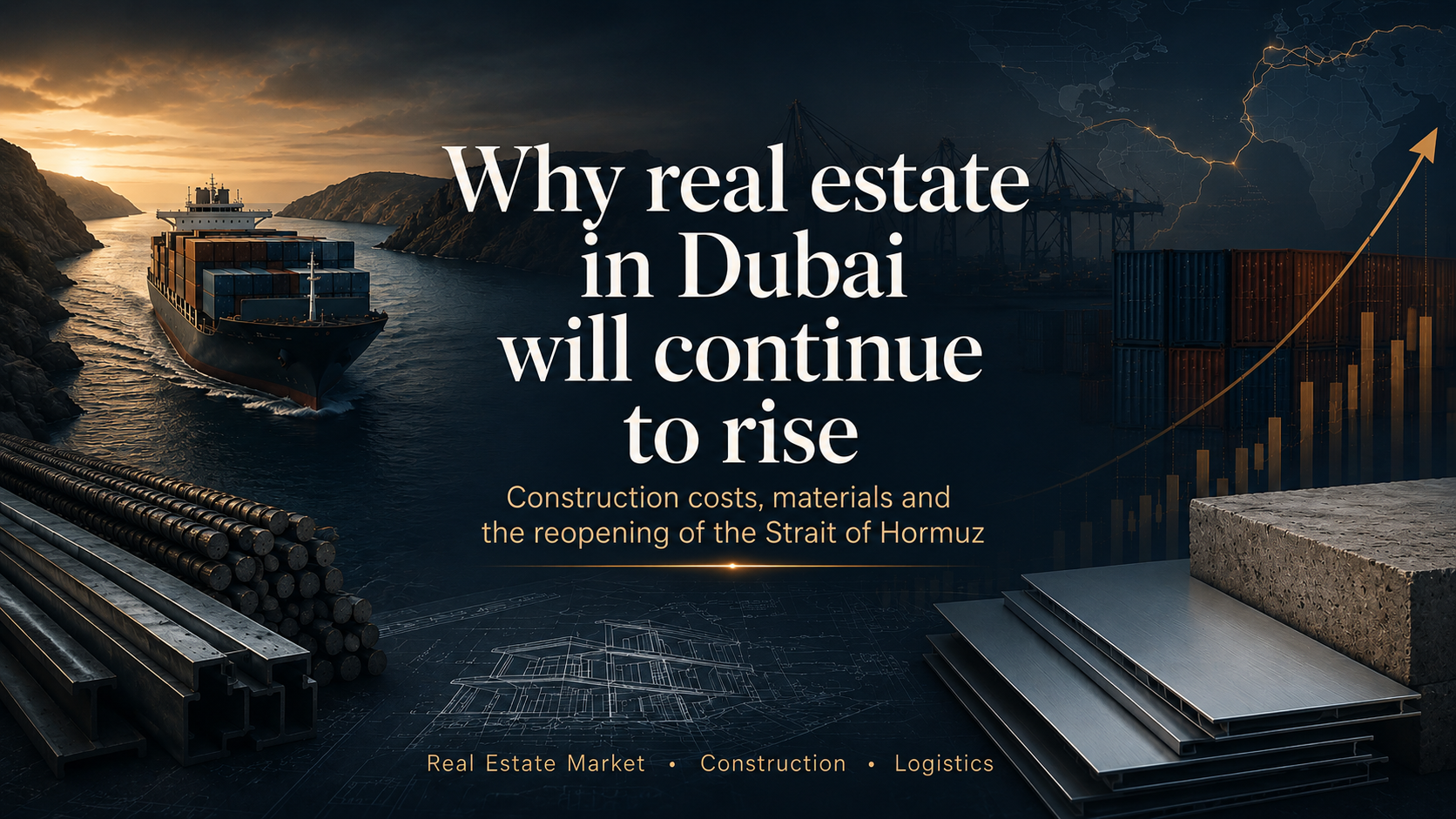
The memorandum signed on Wednesday at Versailles and the formal ceremony at Bürgenstock on Friday 19 June bring to a close one of the most costly logistics crises in the region's history. The Strait of Hormuz is set to reopen for free commercial transit. But for the construction industry and the real estate market in Dubai, relief will not arrive as quickly as it might seem. And that is precisely why this moment matters for anyone considering a property purchase in the emirates.
Before the Conflict, Costs Were Already Rising
To understand the scale of the current problem, it is necessary to go back to the beginning of 2026. Even before 28 February, before the US and Israeli strikes on Iran, the construction market in the UAE was in a phase of strong growth. Dubai's construction sector was projected to reach AED 189.59 billion in value this year, growing 6.2% year on year. The UAE federal budget for 2026 approved expenditure of AED 92.4 billion, a 29.2% increase on 2025, with significant allocations toward infrastructure and industry.
According to Turner & Townsend's 2025 analysis, construction materials already accounted for 60% of total baseline build costs in the UAE. The tender price inflation index stood at 3.3% in 2025, up from 1.9% in 2024. The outlook for 2026 before the conflict anticipated continued growth, but at a manageable level of around 3% according to Currie & Brown estimates.
The conflict changed everything, and very quickly.
What Got More Expensive and Why
The Strait of Hormuz carries approximately 17 million barrels of oil per day, representing one fifth of global consumption. The same corridor handles 20% of global liquefied natural gas trade. When Iran effectively announced the closure of the strait on 4 March, oil prices immediately broke above $100 per barrel. For the construction industry, that was an alarm signal with very concrete consequences.
Steel is an energy-intensive material that is highly sensitive to freight costs. Higher oil prices directly increase both its production and transport costs. As Grovy Developments analysis published by The Gulf Pulse indicated, supply disruptions caused suppliers to shorten the validity periods on price quotes, preventing developers from locking in prices over longer horizons. Grovy CEO Abhishek Jalan estimated the industry saw construction material cost increases of 12 to 18% in 2026, with an average rise of approximately 15% across the full supply chain.
Aluminium is another heavily exposed material, widely used in facades, window systems and cladding. Its production is particularly energy-intensive and its supply chains are complex. As Professor Seyed Ghaffar of the Engineering Department at the University of Birmingham Dubai noted in conversation with Gulf News, the changes are not a uniform price increase but layer on top of each other at different stages of the supply chain. An initial assessment from a Linesight report, the global construction consultancy published by Dezeen in March 2026, made it explicit: disruptions in the Strait of Hormuz would translate into higher prices for aluminium, steel, copper and cement.
Cement remained relatively more stable thanks to local production in the UAE. In Q2 2026, the price of a 50kg bag of OPC 42.5 ranged from AED 14 to AED 17 at trade counters across Dubai, Abu Dhabi and the Northern Emirates, according to FEPY data. Even cement, however, felt the rise in delivery costs, since the raw materials for its production are imported.
MEP components, covering HVAC systems, plumbing installations and electrical distribution panels, represent the fourth key area of cost pressure. This segment absorbs both rising raw material prices and extended delivery lead times resulting from disruptions across global shipping routes.
How the Closure of the Strait Raised Costs Across the Entire Supply Chain
The UAE is deeply dependent on imports. As the Grovy CEO explained to The Gulf Pulse, the UAE construction sector relies primarily on a small number of countries for the majority of its key material imports, and even locally produced products such as concrete depend on imported raw materials. Domestic production can soften some of the pressure, but it cannot eliminate it entirely.
Meanwhile, marine insurance costs surged dramatically. As Khaleej Times reported, war risk insurance premiums for vessels transiting the Strait of Hormuz rose from a standard level of 0.25% of vessel value to between 3% and 8%, translating into bills of $3 million to $8 million for a single large tanker transit. That cost will not disappear the moment the agreement is signed.
The compounding effect is also significant. The Strait of Hormuz has been closed to practical commercial shipping for months. At the same time, disruption in the Red Sea and the Suez Canal from Houthi attacks has cut off the main Asia-Europe route. Ships were forced to route around the Cape of Good Hope, adding 3,500 to 4,000 nautical miles and 10 to 14 days to standard voyages, according to Carra Globe data from May 2026. Every additional week at sea means higher fuel costs, higher insurance costs and longer waits at construction sites.
Opening the Strait Will Not Turn Back the Clock Immediately
This is the point that requires particular attention, because the natural instinct is to assume that once the agreement is signed, everything returns to normal. The data and experts indicate otherwise.
Naval mine clearance across the waters of the Strait of Hormuz could take up to six months, according to Pentagon estimates. Khaleej Times indicates that even with nominal reopening, vessel volumes through the corridor will remain constrained for several months due to the requirement for convoy escorts along narrow, designated safe corridors.
Marine insurers require months of operational stability before reducing premiums to pre-conflict levels. Shipping companies did not return to normal routes through the Strait even during previously announced reopening windows. The Strait effectively became commercially closed, even when it was not physically blocked, and restoring commercial traffic is a different challenge from simply opening the channel.
Construction also operates on multi-month procurement schedules. Suppliers are still holding buffer stocks, but new contracts reflect current prices, not pre-conflict prices.
The opening of the Strait is a fundamental change of direction. But cost pressure in construction will persist for many months after the agreement is signed.
How This Will Translate Into Property Prices
The mechanism is less straightforward than a simple pass-through of higher construction costs into higher sale prices. The Grovy CEO addressed this directly: rising construction costs should not automatically lead to higher off-plan prices, because the market does not have the capacity to absorb such an increase. Developers cannot simply raise prices and maintain sales volumes.
What happens instead has equally significant consequences for the market. Developers with strong procurement strategies and the ability to absorb cost volatility launch new projects. Those without that capacity wait, delay or step back from launches entirely. The result is constrained supply of new off-plan projects in the coming quarters. Lower supply against sustained demand means prices of existing projects in the secondary market and off-plan from strong developers become more expensive.
At the same time, investors who held back decisions over the past months due to geopolitical risk are now returning. When the April ceasefire was announced, the Dubai stock index rose 8.5%, developer shares gained up to 13%, and the conversion rate of enquiries into transactions tripled. The signing of a permanent memorandum is a significantly stronger signal than that temporary pause.
The Coming Months Are Precisely the Window
There is a short period of time between the signing of the agreement and the full market recovery during which inventory is still available at prices that reflect recent uncertainty. Not pre-conflict prices. Not peak prices. Prices from a transitional period that is still in motion.
That period is measured in weeks and months, not years. Real estate does not react overnight, but signals from the stock exchange, from developers and from the conversion market appear immediately. Investors who held decisions through the past months are returning. Developers who waited on launches are returning. New projects are entering the market priced at higher construction costs. Supply in the segment that stalled in March is structurally constrained through the months ahead.
What currently looks like a weaker moment is, in a 12 to 24 month perspective, the entry point that future buyers will remember as the one they should have used. That was true after 2008. It was true after 2020. The mechanism is not new, it is simply rarely this visible in real time.
Off-plan properties purchased now, before the full market recovery, will reach a portfolio at handover when the market will have already repriced higher.
This article is for informational purposes only and does not constitute investment advice. Sources: Turner & Townsend UAEMI 2025, Grovy Developers / The Gulf Pulse May 2026, Gulf News June 2026, Linesight / Dezeen March 2026, Khaleej Times May 2026, FEPY Q2 2026, GlobeNewsWire, Capital Associated May 2026, Carra Globe May 2026, DLD / Edwards & Towers Q1 2026.