How Dubai Protects Your Money: RERA, Escrow and What It Really Means for Buyers
When someone hears about investing in Dubai real estate for the first time, the first question is rarely "how much will I make." More often it is "is it safe." And that is the right question. Because before we calculate returns, it is worth understanding what stands between your money and the risk of something going wrong.
The answer is more concrete than most people expect.
Why Regulation Became Necessary
Dubai was not always a market you could trust. Before the regulatory framework existed, developers collected money from buyers, built or did not build, and buyers had virtually no legal protection. The boom of 2005 to 2008 produced thousands of projects, many of which were never completed. When the crisis hit, many investors were left with nothing.
The Dubai government drew lessons from that period faster than most governments respond to comparable crises. The result is a system that places Dubai alongside the most regulated real estate markets in the world.
RERA: Who Sets the Rules
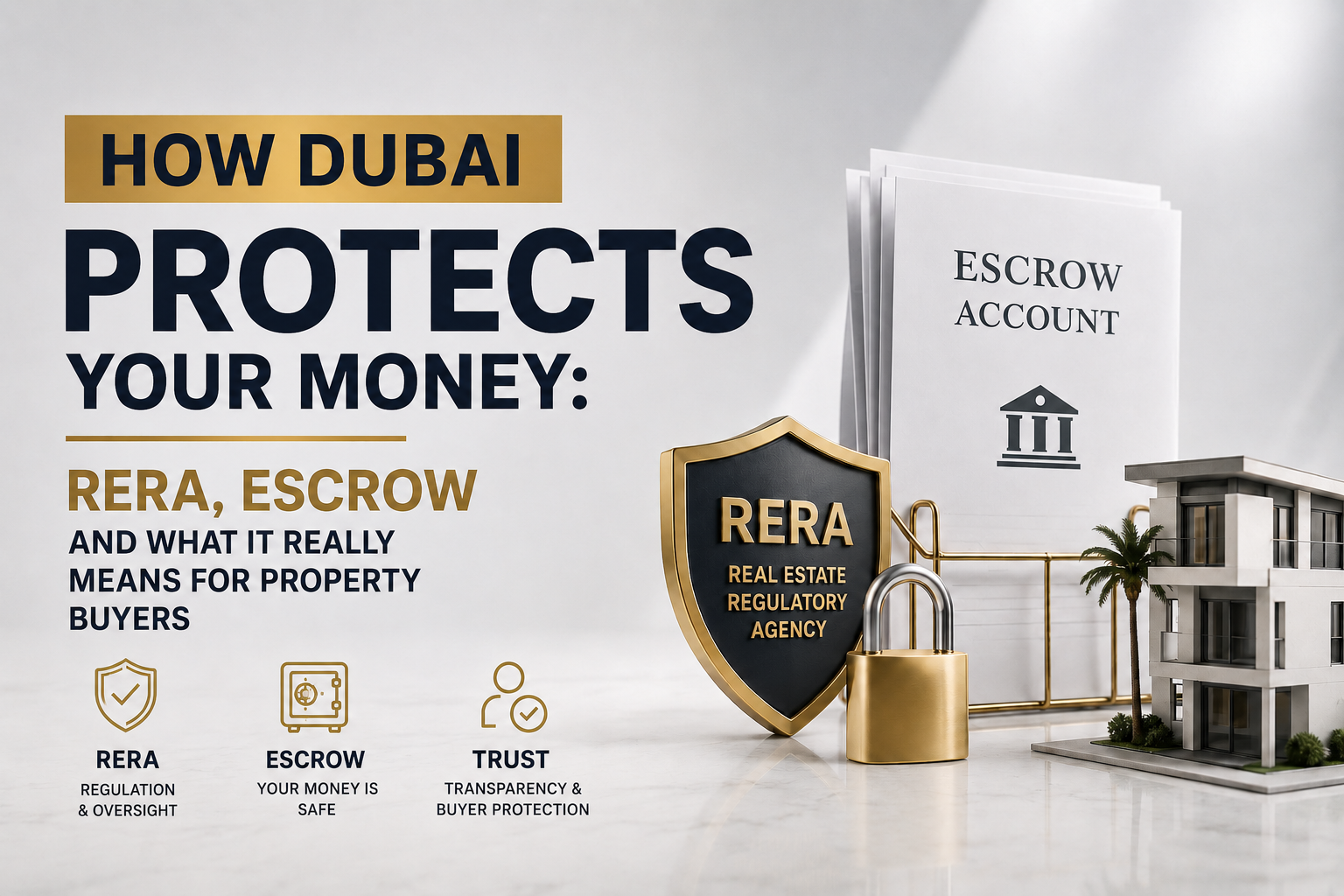
RERA, the Real Estate Regulatory Authority, is the government body established to oversee the entire Dubai real estate market. It is not a paper institution. RERA licenses developers, brokers and agents, registers all transactions, approves projects before they go to market, and has real enforcement power.
In practice, this means no off-plan project can be legally sold without RERA registration. No broker can operate without a licence. Every transaction is recorded in a system that can be verified online.
For an investor coming from outside, this means one thing: if something goes wrong, there is an institution with genuine authority to turn to. In many emerging markets, that simply does not exist.
Escrow: Your Money Does Not Go to the Developer
This is the foundation of off-plan security and probably the most important thing to understand before making a decision.
Dubai law requires developers to maintain separate trust accounts for each project. When you buy off-plan and make an instalment payment, your money does not go into the developer's bank account. It goes into a protected escrow account managed by a RERA-approved financial institution.
The developer only gains access to those funds gradually, as construction progresses, and only after verification by an independent inspector. If the project is not completed, the funds held in escrow are returned to buyers.
This is a fundamental difference compared to many other markets, where payments go directly to the developer and from that point the buyer is relying entirely on the developer's goodwill and financial stability.
DLD and Dubai REST: Transparency You Will Not Find Anywhere Else
The Dubai Land Department, or DLD, registers every real estate transaction in the emirate. Purchase, sale, change of ownership — everything goes into a centralised state registry. The ownership document, known as a Title Deed, is issued by DLD and constitutes irrefutable proof of property ownership.
The entire system operates electronically. No paper bureaucracy, no queuing at a government office. Registration takes place through the official DLD platform, and you have full access to your investor profile through the Dubai REST mobile app.
This is where it gets genuinely interesting. Once logged into Dubai REST, you see all your properties in one place, the current completion percentage for off-plan projects, the results of previous construction inspections together with site photographs, and your full transaction history. You do not need to call the developer to ask how the build is going. You open the app and check for yourself, at any time.
That level of transparency is simply not offered by most real estate markets in the world. It also means the same property cannot be sold to two different buyers — the system detects it immediately. Ownership is verifiable by anyone, at any time.
What This Means for Buyers from Poland or Europe
If you are used to European buyer protection standards, Dubai will not disappoint you. If you have ever invested in markets where a contract is a contract but enforcing it is an entirely different matter, Dubai will be a welcome contrast.
A few things are worth keeping in mind. The system works, but it requires you to buy through licensed agents and from registered developers. Purchasing from an unlicensed individual or through a project not registered with RERA places you outside the protection this system provides. The law is enforced, but legal proceedings in the event of a dispute can take time. Verifying your developer before you buy matters — do not rely entirely on the assumption that the institutions will have done it for you.
Regulation as an Investment Argument
Premium real estate markets differ not only in price but in the level of legal certainty they offer. London, Singapore and New York are markets where investors feel secure not because prices always rise, but because they know what they are buying and have real legal protection.
Dubai has joined that group. It is no longer a market for those willing to accept elevated risk in exchange for higher returns. It is a market that offers both — competitive pricing and yields alongside a protection framework that genuinely works.
And that is perhaps the most significant change that has taken place in Dubai over the last fifteen years. Not the towers, not the artificial islands, not the records. Solid institutions that ensure the money you invest in this market is truly yours.
This article is for informational purposes only and does not constitute investment advice.